I have to admit I have been impatiently waiting for the moment when I could share this teaser of the film my very talented daughter, Charlie Moon, is making for me about The Vintage Shetland Project. The title relates to a section in the book which explains in more detail why I chose the pieces that are featured in the book. These two words alone say so much and for me, sum up the choices I made.
'Perfectly Flawed' offers a glimpse behind the scenes during photoshoots which took place both at the Shetland Museum Archives and on the Island of Vaila. Best of all, it shows some of the garments - and original museum pieces - included in the book.
It is a beautifully and carefully shot film. Charlie has an incredible eye for detail and for the shot that other people just don't see which you can really appreciate in this film. The weather was typical of Shetland in late autumn and we were all battling with fierce winds whipping in off the Atlantic but the light, and, as a result, the colours, are breath-taking.
As I've already mentioned, this is just a preview of a longer film that Charlie is working on which will be screened for the first time at Edinburgh Yarn Festival on Saturday 19th March, immediately after a talk I am presenting all about the Project. The talk and screening take place from 2.30pm and are followed by a Q & A and a chance to have a close look at the pieces from the book. Tickets for the talk and the film screening cost £10 from the Edinburgh Yarn Festival website here.
If you have already purchased The Vintage Shetland Project you can attend the exhibition after the screening free of charge. Likewise if you wish to purchase a book at the event but can't attend the talk you are very welcome to come along to the exhibition afterwards too. I won't be having a stand at Edinburgh this year due to work pressures so this will be my only 'official' port of call for the whole show. I will have helpers available during the exhibition who can take yarn orders which we can send out once I return home but I won't have yarn with me this time. That does mean I will be out and about enjoying the Festival on Friday which I am so looking forward to. You can see more about the event itself here.
And so, Ladies and Gentlemen, without further ado may I present to you for your delectation and delight, 'Perfectly Flawed' by Charlie Moon, featuring Ella Gordon, Ria Moncrieff, Denis Brice, Gavin Crawford and the back of my head! Music by Kathryn Tickell - a piece called Earth and Sky recorded in 2009.
PerfectlyFlawedIntro from Susan Crawford Vintage on Vimeo.
You can of course, still pre order copies of The Vintage Shetland Project from my online shop. and thereby be one of the first people to get your hands on a copy of this very special book.
for now,
Susan xx
Copyright Susan Crawford 2016. Music Copyright Kathryn Tickell 2009.

Showing posts with label shetland. Show all posts
Showing posts with label shetland. Show all posts
Tuesday, January 19, 2016

Saturday, November 21, 2015
My Shetland Adventure Continues
The last few weeks have been incredibly busy. I’ve recently returned from a trip to
Shetland and the beautiful island of Vaila, where I was working on further research
and photoshoots for the Vintage Shetland Project book.
We had originally intended to stay a week, but this turned into just short of two, as gale force winds and high seas whipped up around Vaila preventing our departure. Our wonderful hosts, plentiful food and a huge amount of work to do meant our extended stay was in no way a hardship or a waste of time!
 |
| Arriving on Shetland - copyright Jeni Reid 2015 |
We had originally intended to stay a week, but this turned into just short of two, as gale force winds and high seas whipped up around Vaila preventing our departure. Our wonderful hosts, plentiful food and a huge amount of work to do meant our extended stay was in no way a hardship or a waste of time!
 |
| The stormy seas around Vaila |
The limited hours of daylight at 60 degrees north latitude,
caused a few challenges during the photoshoots.
However, the beautiful images captured on the visit were worth the
horizontal rain and gale force winds.
 |
| Copyright Jeni Reid 2015 |
Here I am being held upright by the wind as we walked to the extreme western edge of the island for a very special view. Hidden inside her parka, is my daughter Charlie, who, along with her chap, Denis, accompanied us to Vaila. Charlie in her role as moving picture Director and Camera-Woman filmed behind the scenes, the photoshoot, and the incredible island of Vaila itself. This stunning footage will be edited together into a short film revealing a unique glimpse of our time on Vaila. Look out for further information of when the film will be available to view.

Denis was also with us for a very good reason, agreeing to be the primary male model in the book. Here he is somehow managing to look completely relaxed whilst surrounded by cameras. You may be aware of an additional photographer behind me in this shot and this is Jeni Reid, who took some amazing 'backstage' photos of the trip which will help decorate the book.
Two days were also spent at the Shetland Museum Archive, where we set up a temporary studio to photograph each of the original museum pieces which are in the book. This was something I desperately wanted to be able to include in the book and thanks to the Crowd Funding campaign I have been able to do so.
Two days were also spent at the Shetland Museum Archive, where we set up a temporary studio to photograph each of the original museum pieces which are in the book. This was something I desperately wanted to be able to include in the book and thanks to the Crowd Funding campaign I have been able to do so.
 |
| Copyright Jeni Reid 2015 |
Exciting new research has revealed some crucial new stories and
developments, which were previously unknown to me, but which are pivotal to the
Vintage Shetland Project story and the completeness of the study as a whole.
Whilst at the Museum, an additional garment came to light - the missing jigsaw
piece in a way - that brings everything together and completes the collection.
I felt it essential to include these new details. So this piece is now already being knitted and will be part of the final photoshoot.
This extra research, knitting and pattern writing is obviously going to take up more time so I have had to move the date of release to the Crowdfunders. All Crowdfunding books will still be sent out first with other pre-orders being sent out shortly afterwards. However for Crowdfunders this does mean that their books won't be despatched until early in 2016. If you are a Crowdfunder you should have been receiving regular newsletters about progress including one earlier this week telling you about this. If you've not been receiving your newsletters please check your spam box for emails from newsletter@susancrawfordvintage.com If there's nothing there either please let us know by contacting tracy@susancrawfordvintage.com
You can also sign up for my regular newsletter by following the sign up link on my website. And don't forget you can still pre-order your very own copy of The Vintage Shetland Project here.
You can also sign up for my regular newsletter by following the sign up link on my website. And don't forget you can still pre-order your very own copy of The Vintage Shetland Project here.
More news very soon, but
For now,
Susan xx
All images copyright Susan Crawford unless otherwise stated. Images not to be used without the written permission of the copyright holder.
Tuesday, November 03, 2015
A Glimpse Inside The Vintage Shetland Project
As many of you know, I'm currently working hard on bringing together my research, patterns, photography and history for The Vintage Shetland Project.
This very special book is based on garments held in the collection at the Shetland Archives. I've selected a number of items from the collection and have meticulously charted and recorded stitch counts and patterns, to enable me to recreate them and from this information create multi-sized knitting patterns. My choice of pieces has not only been based on beauty, but also on the stories which they have each revealed. From the Suffragette Movement to WWII, prize winning knits to highly experimental work the book is proving to be incredibly rewarding and fascinating work.
I've recently held a photoshoot for the book, on the island of Vaila which is off the West coast of Shetland and surrounded by the Atlantic Ocean. It is a truly awe-inspiring and majestic location - but more of that later, first let me introduce you to some of the patterns that will be in the book and also give you a peek at some behind-the-scenes photos.
Here is my beautiful model, Ria, knocking at the door of Vaila Hall whilst wearing these beautiful pair of gloves featuring a Norwegian flower motif and knitted in organic Shetland wool produced from the sheep of Vaila.


One of my absolute favourites is this amazing and highly unusual sleeveless pullover whose pattern and colours echo the rugged landscape and coast of Vaila. If you look to the horizon you can just see the island of Foula in the far distance.

The Vintage Shetland Project featuring 26 patterns, essays and histories is available for pre-order for only £25 (plus p&p).
You can pre-order your copy here
Please note that despatch will commence in early 2016.
The island of Vaila is a very special place, owned by Richard Rowland and his wife Dorota, accessible only by boat and home to Shetland sheep, ponies, seals and many, many sea birds. Richard describes Vaila as a microcosm of all that is Shetland - incredible scenery, nature, space and peace. I'm so very fortunate to be able to use the island as the backdrop for my book.

This very special book is based on garments held in the collection at the Shetland Archives. I've selected a number of items from the collection and have meticulously charted and recorded stitch counts and patterns, to enable me to recreate them and from this information create multi-sized knitting patterns. My choice of pieces has not only been based on beauty, but also on the stories which they have each revealed. From the Suffragette Movement to WWII, prize winning knits to highly experimental work the book is proving to be incredibly rewarding and fascinating work.
I've recently held a photoshoot for the book, on the island of Vaila which is off the West coast of Shetland and surrounded by the Atlantic Ocean. It is a truly awe-inspiring and majestic location - but more of that later, first let me introduce you to some of the patterns that will be in the book and also give you a peek at some behind-the-scenes photos.
Here is my beautiful model, Ria, knocking at the door of Vaila Hall whilst wearing these beautiful pair of gloves featuring a Norwegian flower motif and knitted in organic Shetland wool produced from the sheep of Vaila.

Here I am hard at work, photographing Ria in the gardens of Vaila Hall. She is also wearing a stunning Aquascutum coat from the 1950s.

Here's a detailed shot of the mittens. Typically of the late 1940s/early 50s these mittens have extra long cuffs to ensure the gap between coat and hand is protected. These mittens are knitted in Jamieson & Smith 2ply jumper weight wool.


You can pre-order your copy here
Please note that despatch will commence in early 2016.
The island of Vaila is a very special place, owned by Richard Rowland and his wife Dorota, accessible only by boat and home to Shetland sheep, ponies, seals and many, many sea birds. Richard describes Vaila as a microcosm of all that is Shetland - incredible scenery, nature, space and peace. I'm so very fortunate to be able to use the island as the backdrop for my book.

When you arrive on Vaila you feel you have stepped into a fairy tale - after all how many places do you know that has a watchtower at the bottom of the garden!
And so, my thoughts are turning to the next photoshoot for the book. I'm now on my way back up to Shetland and then to Vaila. I'm excited to see how the landscape has changed since I was there a few weeks ago and also very excited to see the newly prepared pieces in this stunning location! Look out for more behind the scenes photos and shots of beautiful Vaila on my Instagram feed in the next few days.
For now,
Susan xx
Thursday, October 29, 2015
Diamonds Are Forever and It Cannot Fail to Please Released as Single Patterns
I'm really pleased to announce that, due to demand, I have released Diamonds Are Forever and It Cannot Fail to Please as single PDF patterns.
Diamonds are Forever is knitted in the round from the bottom up and features a stunning yoke knitted in an extra-special Excelana 4ply wool limited shade of Deepest Charcoal, to work alongside Persian Grey. The yoke also features Saharan Sand and Sweet Chestnut reflecting the amazing range of natural colours found in the fleeces of our Shetland and Icelandic sheep.

Gentle waist shaping with 1.5 inches of positive ease, creates a flattering yet tailored fit. This design is reminiscent of early 1960s knitwear designs which focussed on what was considered at the time, a woman's more 'active' role in the working world. It also reminds me of the sweaters which Bond Girls from the 1960s wore, (hence the name) and the way that women reflected the changing times with their wardrobe and didn't compromise on design.
This beautiful colourway will be available to order as a very limited edition kit from mid-November. More details will be announced once the kits are ready.

You can buy the PDF pattern from the Susan Crawford shop on Ravelry here (You do not need to be a member of Ravelry to make a purchase from the site).
The PDF pattern costs £5 (however, please see the bottom of this blog for a very special offer).
You can also purchase or take a look at all the possible colour combinations of Excelana 4ply in our shop here.
Materials required:
Excelana 4ply (100% pure British wool - 159m/174yds per 50g ball)
7 (9, 9, 12, 12, 14, 14) balls, shade Alabaster - A
1 ball, shade Saharan Sand - B
1 ball, shade Sweet Chestnut - C
1 ball, shade Persian Grey - D
1 ball, shade Deepest Charcoal - E
Needles and Notions needed:
One 2.75mm (US #2) circular needle
A set of 2.75mm (US #2) double pointed needles (DPNs)
One 3.25mm (US #3) circular needle
A set of 3.25mm (US #3) DPNs
Stitch markers
Stitch holders
The second freshly released pattern, It Cannot Fail to Please, is a beautiful form-fitting pullover, featuring an all-over lace design, which has 4-6 inches of negative ease to really show off the lace detail. It is knitted flat, in pieces, which are seamed together. The lace pattern is incredibly easy to knit and there is only shaping at the armholes and sleeve heads.

Some of you may well know this show stopping sweater from A Stitch in Time volume 1 where it has remained one of the most knitted patterns since the book first came out in 2008! These newly released photographs show the design knitted in our own Excelana 4ply wool in the gorgeous Damson Wine shade.

I'm also pleased to say that I've spent time re-writing this pattern, extending it to include both written and charted instructions, plus additional sizes. I do hope you enjoy it!
You can buy the PDF pattern from the Susan Crawford shop on Ravelry here (You do not need to be a member of Ravelry to make a purchase from the site).
The PDF pattern costs £5 (however, please see the bottom of this blog for a very special offer).
You can also purchase or take a look at all the possible colour options of Excelana 4ply in our shop here.
Materials required:
Excelana 4ply (100% pure British wool - 159m/174yds per 50g)
5 (6, 6, 7, 7, 8) balls, shade Damson Wine
Needles and Notions Needed:
1 pair 2.25mm (US #1) needles
1 pair 3.25mm (US #3) needles
Stitch holder
To celebrate the release of these gorgeous patterns, you can purchase them at 50% off the normal price until midnight on the 1st of November (GMT). Simply use the following code when proceeding through the Ravelry checkout - GULLIVER
Now, I can hear you all asking, what has Gulliver got to do with anything?! Well, Gulliver is our new Shetland Ram! With the invaluable help of The Shetland Sheep Society, we got in touch with a wonderful local breeder who was looking for a new home for one of their favourite rams, Gulliver. Last week, we made the short trip to South Lakeland in Cumbria, to pick up 'Gully' and bring him home to Monkley Ghyll. He's now settled in and waiting

to meet our Shetland ewes on the 5th of November, which is traditionally the date when Shetland rams (or tups), are introduced to the flock. Gulliver has 'Smirslet' marking which intriguingly features back white legs. His fleece is also the less common light fawn which I can't wait to turn into yarn! By putting him in with the ewes on the 5th this ensures that lambs will be born five months later, in April, as the days are starting to get longer again and the weather kinder. And so, with romance about to blossom on the farm, I shall sign off.
For now,
Susan xx
Images Copyright Susan Crawford 2015. Images not to be reproduced without the permission of the copyright holder.
Diamonds are Forever is knitted in the round from the bottom up and features a stunning yoke knitted in an extra-special Excelana 4ply wool limited shade of Deepest Charcoal, to work alongside Persian Grey. The yoke also features Saharan Sand and Sweet Chestnut reflecting the amazing range of natural colours found in the fleeces of our Shetland and Icelandic sheep.
This beautiful colourway will be available to order as a very limited edition kit from mid-November. More details will be announced once the kits are ready.
The PDF pattern costs £5 (however, please see the bottom of this blog for a very special offer).
You can also purchase or take a look at all the possible colour combinations of Excelana 4ply in our shop here.
Materials required:
Excelana 4ply (100% pure British wool - 159m/174yds per 50g ball)
7 (9, 9, 12, 12, 14, 14) balls, shade Alabaster - A
1 ball, shade Saharan Sand - B
1 ball, shade Sweet Chestnut - C
1 ball, shade Persian Grey - D
1 ball, shade Deepest Charcoal - E
Needles and Notions needed:
One 2.75mm (US #2) circular needle
A set of 2.75mm (US #2) double pointed needles (DPNs)
One 3.25mm (US #3) circular needle
A set of 3.25mm (US #3) DPNs
Stitch markers
Stitch holders
The second freshly released pattern, It Cannot Fail to Please, is a beautiful form-fitting pullover, featuring an all-over lace design, which has 4-6 inches of negative ease to really show off the lace detail. It is knitted flat, in pieces, which are seamed together. The lace pattern is incredibly easy to knit and there is only shaping at the armholes and sleeve heads.
Some of you may well know this show stopping sweater from A Stitch in Time volume 1 where it has remained one of the most knitted patterns since the book first came out in 2008! These newly released photographs show the design knitted in our own Excelana 4ply wool in the gorgeous Damson Wine shade.
I'm also pleased to say that I've spent time re-writing this pattern, extending it to include both written and charted instructions, plus additional sizes. I do hope you enjoy it!
You can buy the PDF pattern from the Susan Crawford shop on Ravelry here (You do not need to be a member of Ravelry to make a purchase from the site).
The PDF pattern costs £5 (however, please see the bottom of this blog for a very special offer).
You can also purchase or take a look at all the possible colour options of Excelana 4ply in our shop here.
Materials required:
Excelana 4ply (100% pure British wool - 159m/174yds per 50g)
5 (6, 6, 7, 7, 8) balls, shade Damson Wine
Needles and Notions Needed:
1 pair 2.25mm (US #1) needles
1 pair 3.25mm (US #3) needles
Stitch holder
To celebrate the release of these gorgeous patterns, you can purchase them at 50% off the normal price until midnight on the 1st of November (GMT). Simply use the following code when proceeding through the Ravelry checkout - GULLIVER
Now, I can hear you all asking, what has Gulliver got to do with anything?! Well, Gulliver is our new Shetland Ram! With the invaluable help of The Shetland Sheep Society, we got in touch with a wonderful local breeder who was looking for a new home for one of their favourite rams, Gulliver. Last week, we made the short trip to South Lakeland in Cumbria, to pick up 'Gully' and bring him home to Monkley Ghyll. He's now settled in and waiting
to meet our Shetland ewes on the 5th of November, which is traditionally the date when Shetland rams (or tups), are introduced to the flock. Gulliver has 'Smirslet' marking which intriguingly features back white legs. His fleece is also the less common light fawn which I can't wait to turn into yarn! By putting him in with the ewes on the 5th this ensures that lambs will be born five months later, in April, as the days are starting to get longer again and the weather kinder. And so, with romance about to blossom on the farm, I shall sign off.
For now,
Susan xx
Images Copyright Susan Crawford 2015. Images not to be reproduced without the permission of the copyright holder.
Thursday, September 24, 2015
Home and Away
Autumn has arrived in this part of the world, the days are getting shorter and cooler and the mornings often begin with a mist laying heavy over the valley. It’s a beautiful place to live and work, but at the moment, I’ve had little time to contemplate those lovely views. We are hard at work knitting, finishing, writing, pattern sizing etc all day every day often through to the early hours to make the Vintage Shetland Project the best it can possibly be.
Last week, we began a series of photoshoots which are going to be taking place over the coming month. This first shoot included some of the garments from the Project.

There were also new versions of favourite designs which are being relaunched as single patterns very soon.

Here's I am in photographer mode photographing our fabulous new house model Becky wearing 'Diamonds are Forever' (in a range of suitably sheepy shades) and surrounded by some of our sheep. You can see the 'rear' of our gorgeous new Icelandic ram as he's being fed by Becky. And below, you can just see me going to any lengths to get just the right shot! You can also see 'It Cannot Fail to Please' knitted in Excelana 4ply Damson Wine again being modelled by Becky, braving the brambles and nettles to harvest some of Monkley Ghyll's very own Damsons.

Here I am styling the lovely Becky in the beaded yoke jumper from Vintage Shetland Project with a spectacular 'skirt' created using 8 metres of Vaila Organic Shetland Tweed.

I was so pleased with the photos from this shoot and can't wait to share more of them. In fact if you come along to the Yarndale show at Skipton, North Yorkshire, this coming weekend more of the images will be on display along with some of the finished items from the book. There will also be the opportunity to pick our new promotional brochure with images and previews from the book itself. With so much to do, Gavin and I won't be manning the stand this year, but our wonderful friends and colleagues Tracy, Tess and Jo will be there to help everyone visiting our dedicated Vintage Shetland Project stand. So if you are coming to the show make sure you call at stand 100 to get the chance to see these beautiful pieces from the book and don't forget to pick up a preview brochure.
Due to the huge demand for Fenella during and since the pubslush campaign our stocks are extremely limited until more undyed yarn arrives in October ready to head off to the dyers. Therefore at Yarndale we are only taking orders for Fenella not selling it at the show. There will be lots of information about yarn quantities and colours for the patterns along with the chance to pre-order kits for the likes of the Rose Cardigan.
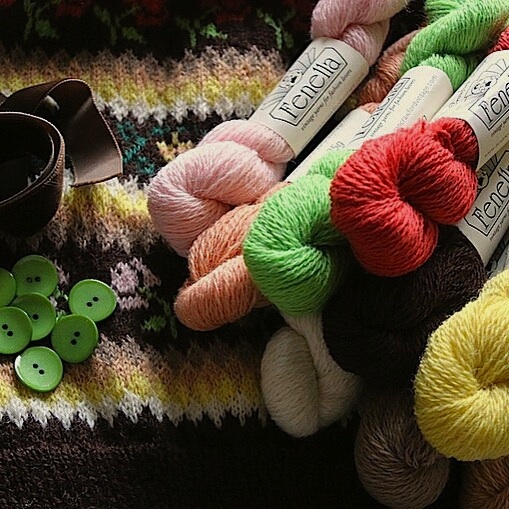
Along with your brochure you can also pick up the new Fenella shade cards featuring all 25 of our gorgeous colours, including the new colours - Sloe Gin, Alta, Melancholy, Balado, Rannoch, Verdigris, Caramel and Dolly Blue (my favourite) - more about these very soon. Kits for designs made using Jamieson & Smith yarns and our other limited edition yarns will be available to order on the website before Christmas.
As I mentioned in my last blog post we've been welcoming many new family members to the farm and just this week we have had a very exciting new addition - Iris. Iris came to live at Monkley Ghyll only last week and has already made a huge difference to efficiency on the farm. Here she is. Our fabulous International 784 vintage tractor. She may look a bit rough around the edges but she's a hard worker and we love her.

When I revealed her on instagram a few days ago I was directed to the The Mike Sammes Singers who sung the jingle for a new version of the International tractor - it was for the 'hydrostatic' which is a much fancier version than ours, however the jingle is well worth a listen :)
Thank you to Felicity Ford for sending me the link to this.
Straight after the Yarndale show I’m heading off up the country to Shetland for Shetland Wool Week. I have a lot of non-wool week work to do for the book whilst I am there but will be hosting the Vintage Shetland Project Trunk Show at the Shetland Museum on Thursday 1st October from 1pm-4pm. There is no booking required and the event is free. I do hope to see some of you there.
For now,
Susan xx
Sunday, September 13, 2015
So that was the month that was...
I mentioned in my last blog post that things would be quiet around here whilst I got on with the myriad tasks in hand for the Vintage Shetland Project, as well as all the other tasks that go on anyway. But I didn't expect it to be a whole month between posts.

August has indeed been incredibly busy. In addition to the research, knitting, finishing, writing, planning etc that is going on just for Vintage Shetland Project alongside the general running of our business, there is an endless list of farm tasks to do as we try to ensure we are ready for the oncoming winter. For the first time we will also be putting our ewes to the tup so come next Spring we will have our first lambs born here at Monkley Ghyll.
Despite the loss of fleece in our barn fire we are lucky to still have a number of Zwartbles fleeces sourced from local farms which will soon be going off for spinning and today we head off to collect a batch of Shetland fleeces from another nearby farm which we hope to turn into yarn very soon too. So although it won't be fleece from our own sheep this year, it will be fleece from sheep who live all around us and I am very, very excited at the thought of these yarns getting spun and what they will be like when they return.
We have added a number of sheep and goats to our little family here at Monkley Ghyll, with some very exciting yarn ideas in mind.

Poppy, Molly, Aretha, Etta, Nina and Simone joined us recently. These beautiful Herdwick sheep have settled in very well, the steep hills and stony ground of our farm seem to appeal to them! Known for their less than soft fleece I am experimenting with a number of ideas enabling us to make good use of this unique fibre.

Alongside them are our two Angora kid goats - Jake and Ellwood - these two boys will produce kid mohair for around three years. Their coats grow at such a rate they can be clipped twice a year and will provide 10kg of mohair each per year.

There are a number of other new arrivals who I will tell you about next but I will leave it there for now as there is much to do as the days grow shorter and the air begins to smell of autumn...

And the autumn mists come rolling up the valley

I'll be back soon,
but
for now,
Susan xx

August has indeed been incredibly busy. In addition to the research, knitting, finishing, writing, planning etc that is going on just for Vintage Shetland Project alongside the general running of our business, there is an endless list of farm tasks to do as we try to ensure we are ready for the oncoming winter. For the first time we will also be putting our ewes to the tup so come next Spring we will have our first lambs born here at Monkley Ghyll.
Despite the loss of fleece in our barn fire we are lucky to still have a number of Zwartbles fleeces sourced from local farms which will soon be going off for spinning and today we head off to collect a batch of Shetland fleeces from another nearby farm which we hope to turn into yarn very soon too. So although it won't be fleece from our own sheep this year, it will be fleece from sheep who live all around us and I am very, very excited at the thought of these yarns getting spun and what they will be like when they return.
We have added a number of sheep and goats to our little family here at Monkley Ghyll, with some very exciting yarn ideas in mind.

Poppy, Molly, Aretha, Etta, Nina and Simone joined us recently. These beautiful Herdwick sheep have settled in very well, the steep hills and stony ground of our farm seem to appeal to them! Known for their less than soft fleece I am experimenting with a number of ideas enabling us to make good use of this unique fibre.

Alongside them are our two Angora kid goats - Jake and Ellwood - these two boys will produce kid mohair for around three years. Their coats grow at such a rate they can be clipped twice a year and will provide 10kg of mohair each per year.

There are a number of other new arrivals who I will tell you about next but I will leave it there for now as there is much to do as the days grow shorter and the air begins to smell of autumn...

And the autumn mists come rolling up the valley

I'll be back soon,
but
for now,
Susan xx
Friday, July 24, 2015
Decoding the Vintage Shetland Project


For those of you who don't know Gavin, he is a graphic artist and designer who worked for over 20 years in the print and design industry before I kidnapped him and lured him into the knitting world to be my partner, continuing to use his graphic design skills to create our self-published books. We both split our lives between the business and the farm and have often struggled financially, however Gavin has never suggested we stop doing what we do, he has never tried to stop me pursuing my dreams, my desire to create better and better books and my endless quest for more research opportunities. He has never once said four years research was too long, too expensive, or self-indulgent. He is endlessly supportive, creative, inventive and tireless and without him I could not do what I do.
So over to Gavin who has written a fabulous piece explaining his significant role in the Vintage Shetland Project.
"When Susan sets out on the process of starting a new book it isn't long before it turns into a joint effort, with myself coming on board for the graphic art side of the project. My role is the creation and layout of the books - preparing the pattern text for styling and typography, editing the photos for colour balance, applying the colour correction needed, preparing any diagrams, schematics and charts, and lastly when everything is complete and ready to go, I create the press-ready CMYK files that will be sent to the printers.
At the early stages of the Vintage Shetland Project was the process of 'reading the garments'. This involved Susan closely studying the garment so as to record the construction and patterning stitch for stitch. We needed a way to transcribe the colour patterns of the many motifs that make up a single Fair Isle sweater. A daunting task in itself, but magnified hugely when the idea of creating a book full of these garments was decided upon.


After some discussion we came to the conclusion that the most productive method would be for Susan to analyse each stitch and dictate it's colour out loud to me, where upon I would sit at the laptop to record the result.
At this point it was obvious to me that I was no longer getting the holidays in Shetland that I'd envisaged - the fishing expeditions and the sightseeing trips I'd planned while Susan was to be busy working at the Shetland Museum Archive - now, I too would be 'busy' with the project.
We needed to devise a clear process, so we would be able to understand and make sense of all the transcribed notes we'd taken when we came to look back on them, at a later time. This was something that I felt needed some careful thought and I had some ideas that would help in the long term.
Along with my many years of graphic arts experience I've also enjoyed computer programming at a hobby level, and have found myself writing many programs to aid me in my work role, often to process photos or create images. In fact, whenever I find myself doing repetitive task at the computer I look to see if I can write a program to automate the process. It has to be said that the process of writing a program can often take more time than it would have, to have just sat there and completed the monotonous tasks that needed doing, but it's the challenge, the problem solving and the creation process that is the enjoyment of the programming - along with that 'Thank Goodness' feeling when it actually works.
Creating a Code
There's a whole host a ways to approach the process of copying the Fair Isle motifs in a garment. I'm sure most people will be familiar with the idea of sitting with a sheet of 'squared paper' or graph paper and a bunch of coloured pens and setting to colouring in the squares - indeed that is a process many Shetlander's have done for years and we've seen many personal collections of motif stitch patterns. Up until very recently, knitting was still taught in schools on Shetland, where children would drawn up motif charts on paper. But we needed a method that would be quicker than this. A method that would create charts that we could reproduce on a computer suitable for printing within a desktop publishing package. So a graphics package would seem like an obvious choice then, or even a knitting stitch design program - but I felt these options would be too slow and restrictive for the amount of work we had to get through. I decided upon a simple code that I could type out as we worked though each garment. That's right, the humble text editor was my choice of software for this task and a simple but well defined code that I could deal with at a later stage, and write come computer code to read it back.
Looking at a selection of garments from the Museum's collection I started counting the number of different colours of yarn each one used; 4, 5, 8 and one with 10 colours. Perfect I thought (being a nerdy programmer type) 'Hexadecimal'! That would give us up to 15 different colours in one garment. For those of you that don't know (and actually want to know) hexadecimal is the name in mathematics given to base 16, also often referred to just as hex. Unlike decimal (base 10) that is represented with the characters 0 through to 9 for the units, the hexadecimal units are represented by 0 through to 9 followed by A, B, C, D, E and F to represent numbers 0 to 15.
I'm sure there are some of you at this point asking 'but why hexadecimal?' (if there is, at all, anyone left reading this!) - all will be explained very soon.
The idea was to give each colour in the garment a number then type that number into the text editor to represent the stitch in the motif. As the motif was transcribed by Susan I would end up with a textual representation of it - something along the line of this:

As you can see, one character represents one stitch. So the reason for using hexadecimal as our code meant that if we get a colour 12 it is represented with the character C, which is still a single character wide. If it was represented as the decimal number 12 it would be two characters wide (a one and a two). As well as it messing up my nice evenly arrange textual grids on screen, a '12' would be difficult later for the computer to read back. How would it know we meant colour twelve and not colour one followed by colour two. Also, computer systems and many programming languages are used to dealing with hexadecimal numbers (as it maps to binary in a more convenient way than decimal does) making it easier for the programmer to use hex than one might first expect.
So off we set, on the process of reading and transcribing garments. First, Susan would write some detailed notes in her note pad about the construction, together with taking lots of measurements and jotting down as much information as possible together with sketches that would enable it to be reconstructed and made into a pattern. At the same time I would take stacks of photos. First a few images of the whole thing front then back. Then more detailed photos of the finer points such as the welt, cuffs, sleeves, collar, sleeve heads etc. Finally finishing up with a close up of each and every motif in order from the bottom up, so we had something to refer to later when we created the charts, once we were no longer in Shetland and no longer had the real thing in front of us to check against.
Next came the coding process: I'd open up a new file in the text editor and make a few notes of my own, such as the garments code that the museum has assigned to it for their database records, together with a brief description and some of the same notes as Susan had made, so we could cross reference our results later. Then, studying each yarn colour we'd give it a code number and compare it with modern day shade cards to see if there was a match to currently available yarns, both in colour and weight - which would all get typed in.
Starting with the first motif Susan would read out the number of the colour, stitch by stitch, beginning at the bottom right hand stitch working to the left, then up to the next row once the first row of the motif had been dictated. Meanwhile I typed the numbers into the text editor, but mine were reading from left to right, and top to bottom, which could be confusing at times when comparing our results.
As many motifs were horizontally symmetrical, i.e. after the centre row the pattern would mirror itself in reverse order, we developed a system that Susan would tell me when we were on the centre row and I would type a TAB followed by a c to denote that this was the centre row. Which saved a certain amount of time.
On and on we went, a motif at a time until the entire garment had been notated. Often taking two to three hours to complete one piece. Some days, we could spend the whole day in the museum archive and only get through two items.
Decoding the Results
We now had a code, but a code is not much use unless it can be decoded! So I set about analysing the data we'd obtained to create a computer program to do something with it. Namely, create a coloured chart ready for the knitting process.
Some say an important decision at the early phase of software development, even before the conceptual process of 'what will it do' and 'how will it do it', or the feasibility of 'can it be a marketable commercial product', is to come up with a really cool, snappy name - or at the very least a really good project code name. After all, would Photoshop be that well known if it was called 'The Painty Program'? Well, as it turned out I couldn't come up with that snappy, cool name, so Fair Isle Decoder is what it became.
Anyway, back to the actual programming task: The first stage was to discover the colour codes we'd assigned. The program looks through the text file until it finds the colour references and the description of the colour, which it display in a window in order. But a very basic colour description such as light blue, isn't much use, so alongside each name is a coloured icon that allows the exact colour to be set for that yarn. When all the desired colours have been set the colour definitions can be stored so that they are remembered for future use, or edited at any time.


The final task is to work through the file and draw the chart for each motif that's been transcribed. It finds the start of the motif which in the file is denoted with the text #start followed by the description or title of the motif that we've given it - usually a simple M1 for the first motif or Peerie etc. It reads each line in order until it finds the text '#end'. Each line is then analysed character by character (stitch by stitch) and each colour number is converted into the appropriate coloured square in the chart, remembering to reverse the order from left to right - top to bottom into the knitting chart of right to left - bottom to top. If it discovers a 'TAB c' at the end of a line then it has to treat this as the centre row and reproduce each of the previous rows in reverse order.


There was one last thing to add to the program and that is the ability to create a key for the charts. This draws the colour square with the name of the yarn colour along side.
 It took a fair amount programming time to get to this stage, but there we have it, each motif is produced as a colour chart, in a vector graphics format, that can be further edited in a standard graphics package. Job done!

... well not quite!
The next stage in the evolutionary process of taking the information we had gathered thus far and turning it into a modern multi-sized knitting pattern now starts to get complicated. That's right, all that previous work turned out to be the easy bit. Yes, very time consuming, long winded, painstakingly laborious, hard on the eyes and extremely tiring by the end of each day, but nevertheless a lot less problematic than what was to follow, and I have to admit, that on other projects and books Susan has done I've never been too much involved with this stage. I am of course referring to process of multi-sizing. During this process a number of the garments brought about some interesting and difficult mathematical problems, inherent because they were never intended to be re-sized. They were personal creations, one offs, even possibly, somebody's own knitting experiment. To investigate how to solve some of these mathematical conundrums we decided we would test things by creating the piece in a virtual way.
The next stage in the evolutionary process of taking the information we had gathered thus far and turning it into a modern multi-sized knitting pattern now starts to get complicated. That's right, all that previous work turned out to be the easy bit. Yes, very time consuming, long winded, painstakingly laborious, hard on the eyes and extremely tiring by the end of each day, but nevertheless a lot less problematic than what was to follow, and I have to admit, that on other projects and books Susan has done I've never been too much involved with this stage. I am of course referring to process of multi-sizing. During this process a number of the garments brought about some interesting and difficult mathematical problems, inherent because they were never intended to be re-sized. They were personal creations, one offs, even possibly, somebody's own knitting experiment. To investigate how to solve some of these mathematical conundrums we decided we would test things by creating the piece in a virtual way.
I took the charts that had been created by my program and dropped them into a graphics package, there I repeated them across the page and arranged each motif and peerie in their correct order to create a virtual fabric of stitches that we could manipulate, cutting away and adding stitches where needed, inserting and removing whole rows until we achieved the sizes required and still keep the integrity of the original garment.


This process worked very well, but it was a lengthy procedure and took quite some time to move sections around just to insert the odd row here and there. It prompted me to think about how the process could be done differently, in a way that could easily be changed and edited but reproduced easily if, for example, we decided to change one of the colours in the charts. The process of creating these full page graphics of all the motifs together, with me at the controls of the graphics package and Susan working from her mathematical calculations, telling me how many motifs across, the number of rows to add of plain colour between between set of motifs made me realise that what was actually needed was a textual 'description' of how it should look, that could be easily edited and then adapted for testing other sizes.
My Fair Isle Decoder program already had most of the code I needed. It could produce individual charts and a key, so it just needed some extra method of being told how to draw everything required all on one page. Trying to describe how a page full of charts are positioned could possibly be a very lengthy and wordy process, but to me (being the nerdy computer type that I am), an obvious way to approach it is to handle it like it's a computer program itself. Or more accurately a scripting language. And so the 'Visualiser Script' was added to my Fair Isle Decoder.
Visualiser Script
The basis of the scripts are themselves just simple text files, containing descriptive commands, or functions to instruct it to draw what we want, where we want it. As a very simple example, lets say, we want the first motif repeated 10 times across the page, followed by the Peerie motif then the second motif. The motifs are numbered sequentially in the order they are written in the initial file we originally transcribed. So if the peerie was the 8th one described we would create a script as follows:
motif(1,10)
motif(8,10)
motif(2,10)
A whole host of functions allow some very complex design to be quickly and easily constructed. I'm constantly adding more functions when I come across a need for it to do something extra.
Some of the more commonly used functions are:
motif() - draws a motif, with the option of it being repeated many times.
partmotif() - draws just a part of a motif, with full control over which part is drawn.
plain() - draws a block of a single plain yarn colour for a given number of stitches and rows.
 There are plenty of others that are pretty much self explanatory from their names, such as:

repeatbox(), text(), line(), position(), arrow(), key().
The emphasis behind it all, is that it can produce a graphic image that is ready to be included in the book, at a quality that's ready for printing, and that no further editing needs to be done in a graphics package before it can be used.
 To date, the entire program stands at a total of 14,583 lines of computer code, an untold number of hours and still no fishing!"

I'm sure you'll agree with me that Gavin's programme is in itself a truly amazing development and without it the progress on the Vintage Shetland Project would have been infinitely slower and Gavin really deserves a huge, resounding cheer from us all!
If you would like to support the Vintage Shetland Project and pre-order your copy of the book please go to my pubslush page. The campaign runs for another 2 weeks and is the only way to be sure of getting a copy of the book before Christmas.
for now
Susan xx
Sunday, July 12, 2015
WOW!
Wow! Its amazing. It really is amazing. I can’t believe it. This is all I have been capable of saying for the last 24 hours since my crowdfunding appeal for the Vintage Shetland Project hit my initial target of £12,000. I had hoped, hoped really really hard, that the target would be reached and maybe passed but I had expected it be a long, slow process, taking most of the 30 days to achieve its aim. I never in all my wildest dreams even considered the scenario that has actually unfolded.
I cannot begin to tell you how much it means to me that other knitters appreciate the project, understand and acknowledge the work and time that has and still is involved, and have been prepared to support my campaign. When you spend over 4 years working on something, you, rightly or wrongly, begin to think that people must be sick of hearing about a project that is just going on and on. It such an overwhelming relief to know that so many of you ‘get it’. In fact, ‘overwhelming’ best describes my feelings over these last 24 hours. I am really struggling to put into words how I feel. Overwhelmed is the only word that sums it up!
So is it all over now, or do I still need your support? I really, really still do. The initial target of £12,000 was to cover the printing of the books and hopefully also go some way to paying for the final photoshoot. There are still many other aspects of the project that need paying for that I didn’t include.
On my crowdfunding page there is an “interview with Susan” where I have asked myself the question ‘what will you do if you exceed your target?’
At this stage depending on how much the campaign exceeds its target, there are a number of things I would like to use the funds for:
Pay for more of the photoshoot costs.
Pay for a second photographer to take ‘behind the scenes’ footage of the photoshoot to enhance the book further.
Have an additional 'set' of sample garments made to enable me to have trunk shows to promote the Project and explain to people the story behind it.
Have an additional 'set' of sample garments made to enable me to have trunk shows to promote the Project and explain to people the story behind it.
Help pay for additional research to make the book even better.
Help pay for image licencing so I can increase the number of historical images included in the book.
Basically, I want to continue making the book better and better, more complete, more beautiful, to enhance the reading and ‘using’ experience for each and every funder.
There are more things I will need to look into if funding continues to grow. Ensuring an efficient distribution system so that everyone gets their books promptly is just one of these things, and with this in mind I have had to make a decision.
Only people ‘ordering’ their book through the crowd funder will be guaranteed of their book being despatched prior to Christmas. I won’t open up general pre-orders on my website until the book is off to the printers and I won’t be able to promise pre-Christmas delivery on these orders. So if you would like your book for Christmas the only way to be sure is to use the crowd funder. Don’t forget the crowd funder closes on the 8th August. By doing it this way I should be able to handle the work load and not risk letting people down.
You can support the Vintage Shetland Project here
Finally I just want to thank everyone once again for all the incredible support I have received. From contributors, tweeters, instagrammers, facebookers, all my fellow blog tour participants and in particular, several amazing women who I will write about in another post, without whom this fund raiser would absolutely not have happened. In fact, everyone in the great big beautiful world of knitting. Thank you - and good night!
for now,
Susan xx
Thursday, July 09, 2015
The Vintage Shetland Project Crowdfunder Campaign

I am very, very, very, very excited to announce the launch of my first ever crowdfunding campaign to raise funds for the printing of the Vintage Shetland Project.
I have agonised long and hard about taking the crowdfunding route as its not something I have done before nor would I normally think about using this particular method of fund raising. However after taking part in Donna Druchunas’ blog tour for her forthcoming book, I realised how I could offer people interested in the project so much more by using a crowdfunding platform rather than offering straight forward pre-orders.
So first let me introduce you to the Vintage Shetland Project

The Vintage Shetland Project is the culmination of several years research I have carried out at the Shetland Museum archive and on Shetland with the help and support of Carol Christiansen, Curator at the Shetland Museum.

Through this research I have chosen 25 items and have transcribed their construction, stitch by stitch, row by row, and have then recreated them for the Vintage Shetland Project. These have then been developed into comprehensive multi-sized knitting patterns, complete with instructions, technical advice and of course, beautiful photos all shot in Shetland. The story behind each hand knit is also told throughout the book along with a fascinating chapter about the four year project and the work involved.

The project has become a huge part of my life and has involved numerous journeys to Shetland to work in the archive, the creation of our own custom-built software to 'translate' my transcriptions and even the manufacture of a yarn brand 'Fenella' to match exactly some of the vintage garment weights and colours.
The book will be A4 in size with a hard cover to match A Stitch in Time volume 1 and will have approximately 250 pages. The book will retail at £25.00 (plus P&P).
So how do you get to be one of the first people to get hold of the book?
The first thing to do is go to my pubslush campaign page
There is much more detail about the book here along with a short extract and most importantly around 20 different rewards to choose from - yarn rewards, to kits to make your own Vintage Shetland garments, experiences such as tea with me at Shetland Wool Week, a work shop on the farm or a chance to spend the afternoon going through my pattern archive and VIP invitations to the Vintage Shetland book launch and not forgetting of course, print books and ebooks.
The campaign will run for 30 days and I hope to raise £12,000 to cover the printing costs for this very special book.
To celebrate and support the launch of the campaign I have put together a fabulous blog tour “To Shetland and Back” with a host of wonderful knitty friends revealing their favourite projects from the book with each post. The tour starts in Shetland, meanders around the world, stopping back at Shetland now and again, and finally ends in Shetland with Donna Smith, patron of Shetland Wool Week. Each participant will be sharing a project from the book so you will get to see more of what is in the book. There will also be other ad-hoc podcast appearances and other blog posts throughout the month and if you follow me on instagram I will be posting a Vintage Shetland Project image each day of the campaign. Do pop back to the blog at 12.30 today for a full list of the blog tour and an introduction to the first stop on the blog tour.
To support the campaign please go to
"Fashion and history intertwine in the Vintage Shetland Project as Susan Crawford recreates and explores cherished pieces from Shetland's rich knitting heritage"
Thank you so much and I do hope you will be able to support the campaign.
for now,
Susan xx
Subscribe to:
Posts
(
Atom
)