Today is a very important day. It is Mass Observation Day in the UK.
76 years ago today the Mass Observation Archive asked the populace
at large to record everything they did from when they got up to when they went to bed - and today 76 years later, the archive is asking everyone to repeat the process. These diaries will then be kept alongside those from 76 years ago and will provide historians with a fascinating comparison and insight into how our world has changed or remained the same.
I am somewhat obsessed with mass observation diaries and have learnt much from the often seemingly innocuous, almost throw-away mentions of what someone was wearing or what they were knitting, sewing or repairing.
One of the most famous mass observation diarists is of course, Nella Last. Known as housewife 49 to the Mass Observation archive she wrote hundreds of thousands of words about her 'ordinary' life in Barrow in Furness. If you haven't read the three published books of Nella's diaries, I would highly recommend them.
A fascinating anthology of observations can be found in "Speak for Yourself" first published in 1984. Many of the observations in this anthology are recorded by full time observers who travelled the country often anonymously recording life going on around them. In the early days much of this was done surreptitiously, with observers even sometimes 'infiltrating' organisations or groups to obtain a better picture of it. This covert-ness shocks me and yet I am well aware of how people change if they know they are being observed. It is now out of print but if you can get hold of a second hand copy it is a fascinating read.
I have begun my diary of today to forward to the archive. I am excited to be included in something that means so much to me. If you would like to submit your diary too you can find out exactly how to go about it on the Mass Observation web site here -
http://www.massobs.org.uk/12may
so for now,
Ruby xx

Showing posts with label history. Show all posts
Showing posts with label history. Show all posts
Sunday, May 12, 2013

Monday, May 06, 2013
Favourite things

 |
| A vintage find with all 6 cases included |
 |
| My Ruby nan's cruet set including mustard pot |
 |
| Some of my rather large collection of tea cups |
 |
| My enamel bread bin - battered but loved! |
 |
| My great grandmothers sherry glasses |
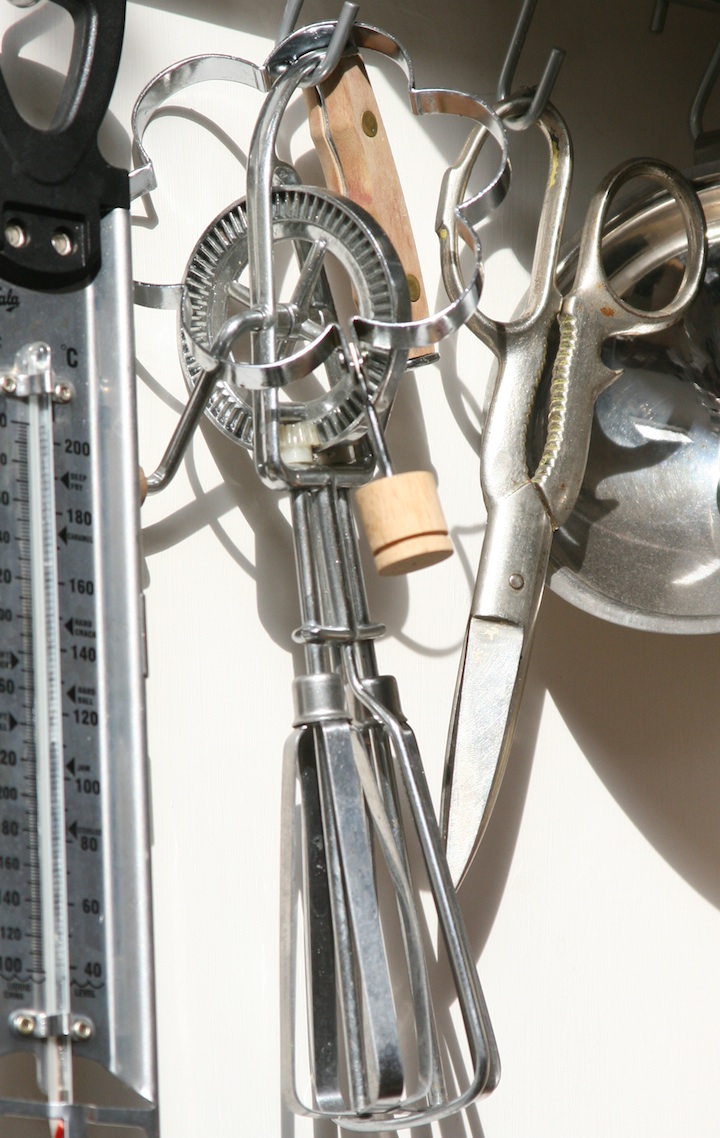 |
| Hand whisk originally belonging to my Ruby nan, beautiful scissors found in the garden! |
 |
| Mini milk bottle dug up from the garden in perfect condition |
 |
| Fabulous 1970s pottery found in a box |
 |
| Empty black treacle tins - both the tins and the treacle are favourite things! |
 |
| Part of large vintage tea and coffee set bought at a car boot sale |
 |
| Six hand painted glasses and jug bought at a garage sale for 50 pence |
 |
| Part of a 1930s coffee set that was one of my first ever vintage purchases |
 |
| The clock isn't vintage but our kitchen wallpaper is made up of overlapping out of date ordnance survey maps of places we have been to. One of my most favourite of all my favourite things! |
for now,
Ruby xx
All images copyright ©Susan Crawford 2013
Saturday, March 30, 2013
Vintage Day with Wool and Willow
On an extremely cold and snowy day last week, Gavin and I set off for Oxfordshire to spend the day with some lovely ladies who were all very interested in hearing me talk about Vintage knitting and Vintage clothes. The event was arranged by the wonderful Julia who owns Wool and Willow which is located in the lovely market town of Wallingford. Julia has created a fabulous display in the shop window featuring Excelana which looks so lovely.


However the talk and mini-workshop were held in the 'Friends Meeting House' which was a beautiful venue set back from the street in its own little courtyard. The building was built in 1724 and still contains all the original benches etc from that period.

This photo was taken when the weather was rather warmer than it was when we visited! The snow came down heavily the whole time we were there so I was very grateful to be tucked away in the snug meeting room with lots and lots of knitwear.

So here we are all set up at the meeting house with a selection of garments from A Stitch in Time Volumes 1 and 2, Vintage Gifts to Knit and Coronation Knits aswell as single patterns such as Frances, which you can see behind me on the right hand side of the photo. I'm holding up The Rose Jumper from A Stitch in Time Volume 1 and explaining in detail its very clever construction.

The ladies present asked lots of questions and also provided some very interesting facts about wartime knitting too. You can just about see that I'm wearing the Fair Isle Cardigan, part of the Fair Isle Twinset from Volume 2. The jumper part of the twinset is also on display on the mannequin on the far left of the photo. I find I wear this cardigan all the time and desperately want the jumper to match but alas don't have the time to knit it!

We also discussed the amazing attributes of many of the garments which feature negative ease. This is Such Flattering Puff Sleeves - again from Volume 1 which employs it to great effect. I also used negative ease when designing Frances so that the cables are stretched by the wearer and create a fabulous figure hugging shape.

You can see how it works on our lovely model who looks completely fabulous in both the cardigan and the colour - which is of course, Excelana Nile Green.
Once we got started everyone was trying on the garments. Here is Concentrate on the Sleeves from Volume 1 looking stunning as it always does. You can also knit this one using Excelana DK.

and Designed in Paris from Volume 2 proving that vintage garments can also be relaxed as well as formal. This design also uses Excelana 4 ply in Cornflower Blue and Alabaster.

The snow has finally cleared away but to finish here's a little snap of me at the start of our journey south at the top of Parbold Hill in Lancashire.

Keep warm!
for now,
Ruby xx


However the talk and mini-workshop were held in the 'Friends Meeting House' which was a beautiful venue set back from the street in its own little courtyard. The building was built in 1724 and still contains all the original benches etc from that period.

This photo was taken when the weather was rather warmer than it was when we visited! The snow came down heavily the whole time we were there so I was very grateful to be tucked away in the snug meeting room with lots and lots of knitwear.


Once we got started everyone was trying on the garments. Here is Concentrate on the Sleeves from Volume 1 looking stunning as it always does. You can also knit this one using Excelana DK.


The snow has finally cleared away but to finish here's a little snap of me at the start of our journey south at the top of Parbold Hill in Lancashire.

Keep warm!
for now,
Ruby xx
Saturday, February 09, 2013
A 'Chat' on Good Grooming
Searching through my library of vintage craft books earlier today I came across an intriguing essay published as part of The Pictorial Guide to Modern Home Needlecraft (Odhams Press - 1938).
Entitled A Chat On Good Grooming it explains how you should plan your wardrobe to ensure you will always be well groomed, without resorting to the additional cost of new clothes!
Far more dictatorial than chatty in style it provides the reader with some basic rules to follow to achieve this goal:

The text goes like this:
It all ends a bit abruptly really, as you rush out to find hammer and nails to put your hanging corner wardrobe together! I'm really not sure how this article really explains how to do things without any additional expense and it brings up some strange suggestions which I haven't heard before, such as only wearing smooth accessories with smoothly textured clothes; its not something I have ever or am ever likely to give very much thought to!
And I have to say that as a red head with a rosy complexion I take great exception to not even being included in the list of complexion types which are all apparently inferior to the English type! With the benefit of over 80 years hind-sight it certainly seems an odd thing to say.
And yet, I have never felt comfortable wearing a mid-length coat with a longer skirt so that just a few inches of the skirt shows below and I've never really thought about why. But as a combination it certainly does lack balance so maybe I really do need to start matching the textures of my accessories to my clothes!
for now,
Ruby xx
Entitled A Chat On Good Grooming it explains how you should plan your wardrobe to ensure you will always be well groomed, without resorting to the additional cost of new clothes!
Far more dictatorial than chatty in style it provides the reader with some basic rules to follow to achieve this goal:

The text goes like this:
How can the busy housewife or business girl be well groomed? How can it be done without additional expense for clothes?
One of the first essentials is to dress to your "type." Consider whether you are tall or short, slim or plump, angular or not, fair or dark, or just between. A few simple rules will help, but they must not be followed slavishly because there are always some people who are exceptions and you may be one of these.
1. Dark complexions and dark hair need warm colours, reds, oranges, yellows and warm browns. Warm complexions need warm colours; cold colours would throw up and intensify a warm complexion to a ruddy glow.
2. Dark hair and pale skin can wear cooler colours than the dark-complexioned type.
3. Fair hair and fair skin, the English type, can find a shade in any colour range to suit; silhouette will really be the deciding factor here. The short, plump figure should choose the darker shades, while the taller slim one may wear the lighter, bright hues.
4. A well-balanced garment never has a line cutting it in half horizontally; a line of any kind, either the hem of a costume coat or a seam, running round the figure halfway between shoulder and hem will have the unpleasant effect of dividing the garment into two equal portions. Either the bodice or the skirt must be the more important.
5. Find out what style suits you and keep to it, adapting it to prevailing fashion; not wearing it to the exclusion of the fashion in vogue.
6. As to colour schemes, never have more than two main colours and one of these must predominate. Do not have every accessory in the same contrasting colour. One accessory must be more important than the rest. Thus, as a guide, a navy suit would look well with:
(a) Navy hat with small trimming of cerise, navy shoes, navy blue gloves with cerise stitching and a navy suede hand-bag.
(b) small red hat, gloves to match the hat, blue shoes and bag.
(c) Red hand-bag and all other accessories in navy with red trimmings, or a red scarf.
These are only hints but they apply to any colour scheme. Here are some more generally known hints:
Vertical lines add height, or rather, give an illusion of more height. Horizontal lines or stripes give width. So if you wish to avoid extra height or width do not wear stripes that bring about such an effect.
Only the slimmest figure can wear gowns with the clinging "cut on the cross"line.
There is always just the right hem length; any deviation from it will upset the balance of the garment.
Do not mix sports clothes with dressy clothes; makes sure, too, that accessories are consistent with the rest of the outfit. Smooth textured cloth needs accessories of smooth texture too. The outfit should have one special feature or focusing point, such as a touch of contrasting colour, a carefully chosen trimming, or buttonhole, or dress ornament.
One other point which is very important, keep all clothes including footwear in good repair. This is not an extravagance but an economy, it is essential to those who wish to look well turned out.
Is the arrangement of your wardrobe well planned? Have your dresses plenty of hanging room? A wardrobe should be high enough to allow the longest evening gown to hang full length. If it does not, then a hanging corner wardrobe, having a wood top and side curtains will be better.
It all ends a bit abruptly really, as you rush out to find hammer and nails to put your hanging corner wardrobe together! I'm really not sure how this article really explains how to do things without any additional expense and it brings up some strange suggestions which I haven't heard before, such as only wearing smooth accessories with smoothly textured clothes; its not something I have ever or am ever likely to give very much thought to!
And I have to say that as a red head with a rosy complexion I take great exception to not even being included in the list of complexion types which are all apparently inferior to the English type! With the benefit of over 80 years hind-sight it certainly seems an odd thing to say.
And yet, I have never felt comfortable wearing a mid-length coat with a longer skirt so that just a few inches of the skirt shows below and I've never really thought about why. But as a combination it certainly does lack balance so maybe I really do need to start matching the textures of my accessories to my clothes!
for now,
Ruby xx
Tuesday, July 31, 2012
The Anniversary of the third battle of Ypres

I was going to post a new blog post today but today is the 31st July which is the anniversary of the third battle of Ypres or Passchendaele, the day great uncle Herbert is thought to have died, so I just thought I would ask you all to remember all the young men who died on this dreadful day and also if you haven't downloaded it yet, do download a free copy of Herbert's Scarf so that you can make his scarf in remembrance. If you haven't read about Herbert's story you can read it on this post from April.
for now
Ruby xx
Sunday, July 22, 2012
The Comforts Committee

Browsing through vintage knitting patterns this afternoon I found this beautiful illustration on the back cover of "Knitting for the R.A.F" published by the Royal Air Force Comforts Committee, based at 20 Berkeley Square, London.

Ration coupon-free wool could be obtained by 'Working Parties' of at least 10 people, on the understanding that all items made from the wool would be for the Royal Air Force and would be sent directly to the Comforts Committee. An official Registration Certificate would be issue to the group on receipt of a Form of Guarantee, which had to be signed to acknowledge the undertaking being given.

The Comforts Committee was established by the Air Council in 1939 with the following purposes:
1. To ascertain the requirements of the Royal Air Force in both patterns and quantities of comforts required.
2. To arrange for the collection and storage of gifts in kind made to the Royal Air Force and to use cash donations to their best advantage.
3. To supervise the distribution of comforts within the Royal Air Force so as to ensure fairness and economy.
The bit I really 'like' is this: "The Committee consists of representatives of the Departments of the Air Ministry directly concerned with the welfare of the Royal Air Force, 'assisted by two lady members'.
Now I am only guessing, but I would imagine the two lady members probably did a little more than assist the Committee and yet even in the pattern booklet itself the airwomen of the W.A.A.F. are portrayed in a rather stereotypical fashion.

Whilst there is no doubting this is a great sketch it seems somehow inappropriate to depict a member of the armed forces plumping up a pillow or possibly sewing something in a suggestive manner to illustrate the knitting pattern in question, or here, hopefully, playing leap frog?

To balance this though this airman is shown comically yet still manfully, endeavouring to darn his socks!

I love this booklet nonetheless and it certainly wouldn't be true to the period if there wasn't a little bit of condescension thrown in here and there.

To encourage participation and involvement the scheme provided an enamel badge to each 'Working Party' registered, with additional badges available at the cost of one shilling. Heads of working parties were encouraged to only allow party members to acquire a badge if they contributed around a 100 hours of their time to the Comforts Committee.

Acknowledgement slips were attached to each knitted item so that the airman or airwoman receiving it could respond in person if they so wished. The whole scheme itself is incredibly practical and well organized, ensuring that the best use was made of limited resources and people's efforts and desire to help. Finally to spur knitters on further, there was a letter from the Secretary of State for Air no less entreating and thanking knitters for their efforts.

for now
Ruby xx
Friday, May 14, 2010
Vintage Shetland
I recently returned to Shetland to visit the Shetland Museum Archive, where I am working on a very special project in collaboration with the Museum. The Museum houses an incredible collection of hand knitted garments, many from the 1920s-1940s. All of this knitwear has been made by people (usually women) living and working on the Islands.
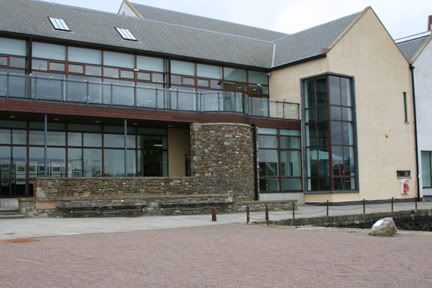
The Shetland Museum
Much of this knitwear has been kept either by family or descendants of recipients and at some point the decision has been made to donate the garment to the Museum collection. As you can imagine many of the pieces have deteriorated considerably over time and as none of these pieces of knitting have written patterns the garment itself is the only record of the effort, the design, the history.
Only a small selection of the knitwear is on display at the Museum itself, the remainder is housed in an archive building elsewhere on the main island. This is where I spent several days examining, photographing, measuring and transcribing stitch by stitch a selection of these garments.
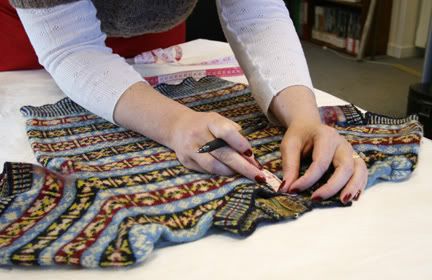
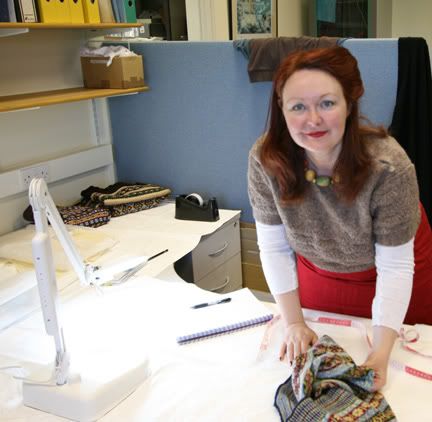
Here I am in the process of transcribing a jumper from the 1940s.
From this information I will choose about 18 to 20 of the garments which I will then write multi sized patterns for. The task of knitting the garments to match the originals as closely as possible will then begin. Once all this has been done and the patterns have been tested and checked and the stories behind the jumpers written and the photographs taken and the artwork, layout and printing done, Vintage Shetland will be published!
This is obviously a long project and the work has only just begun but I will be sharing progress as I proceed.
We managed to have a little time off while we were there and attended a 'Hamefaring' - My good friend Connie of Jamieson & Smith had married in New Zealand earlier this year and the hamefaring was held for those of us who couldn't make the trip. Unfortunately I didn't get any photos of the evening but I learnt both a waltz and a reel. The next morning Gavin and I went for a walk around the headland.
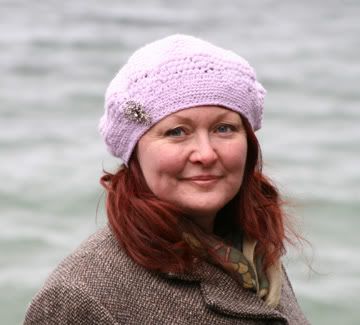
Here I am in my Beret for Country Walks from A Stitch in Time.
I have another trip this weekend, this time to Devon, and then I'll be back to prepare for the publication of Vintage Gifts to Knit - Yaaay!
for now
Ruby xxx
The Shetland Museum
Much of this knitwear has been kept either by family or descendants of recipients and at some point the decision has been made to donate the garment to the Museum collection. As you can imagine many of the pieces have deteriorated considerably over time and as none of these pieces of knitting have written patterns the garment itself is the only record of the effort, the design, the history.
Only a small selection of the knitwear is on display at the Museum itself, the remainder is housed in an archive building elsewhere on the main island. This is where I spent several days examining, photographing, measuring and transcribing stitch by stitch a selection of these garments.
Here I am in the process of transcribing a jumper from the 1940s.
From this information I will choose about 18 to 20 of the garments which I will then write multi sized patterns for. The task of knitting the garments to match the originals as closely as possible will then begin. Once all this has been done and the patterns have been tested and checked and the stories behind the jumpers written and the photographs taken and the artwork, layout and printing done, Vintage Shetland will be published!
This is obviously a long project and the work has only just begun but I will be sharing progress as I proceed.
We managed to have a little time off while we were there and attended a 'Hamefaring' - My good friend Connie of Jamieson & Smith had married in New Zealand earlier this year and the hamefaring was held for those of us who couldn't make the trip. Unfortunately I didn't get any photos of the evening but I learnt both a waltz and a reel. The next morning Gavin and I went for a walk around the headland.
Here I am in my Beret for Country Walks from A Stitch in Time.
I have another trip this weekend, this time to Devon, and then I'll be back to prepare for the publication of Vintage Gifts to Knit - Yaaay!
for now
Ruby xxx
Wednesday, January 21, 2009
Before and After
The ongoing internet router dilemma forced a huge move round, sort out, re-organise of rooms in the house and has left me with my computer still in the kitchen now on its own little table for now, BUT with a lovely work room/studio. I thought it would be best to show you the transition visually, beginning naturally with before...


And after...

somewhere comfortable and relaxing to sit

a work table with space on it to work


shelves of inspiration

Ruby nana's sewing machine, still in working order

An early 1960s LBD,

The original 1930s fireplace newly opened up.
So now you know what exciting stuff I've been up to for the last couple of weeks! However a new sense of calm and purpose is beginning to surface from my post new year blues, all that sorting has done me good. I will leave you with this photo that I found on my camera, taken on January 2nd when the piglets where only 2 days old.

You can just see this little chappie waking up his mum by butting her in the snout! whilst the others sleep under their heat lamp.
for now
Ruby xx
And after...
somewhere comfortable and relaxing to sit
a work table with space on it to work
shelves of inspiration
Ruby nana's sewing machine, still in working order
An early 1960s LBD,
The original 1930s fireplace newly opened up.
So now you know what exciting stuff I've been up to for the last couple of weeks! However a new sense of calm and purpose is beginning to surface from my post new year blues, all that sorting has done me good. I will leave you with this photo that I found on my camera, taken on January 2nd when the piglets where only 2 days old.
You can just see this little chappie waking up his mum by butting her in the snout! whilst the others sleep under their heat lamp.
for now
Ruby xx
Subscribe to:
Posts
(
Atom
)