Vintage Knitting, Retro Dressmaking, Make do and Mend, Original and Vintage Inspired Knitting Patterns, Vintage Inspired books

Wednesday, April 25, 2012

Fair Isle Dilemma

I will soon be heading back to Shetland after quite a long absence to continue with my work on Vintage Shetland. This book will be looking at a selection of 20th Century knitted items in the Shetland Museum Archive. The items have no patterns so I am creating patterns from the source knitting, recreating the garment and multi sizing the pattern. There are a lot of other elements to the book including the story of each of the chosen items, but before I get to that point I need to narrow down my choices to just 20 items from the entire 20th Century archive! What a very very difficult choice to make. And this is where I need your help.

I have two quite similar cardigans both of which I love but which can't both make it into the book as they are just too close in too many ways. So, I'm going to leave it to the public to decide as they say. I'm going to share some photos of each cardigan with you and I would like you to tell me which you think should make it into the book and why. And to give an added incentive there will be a shetland yarn goodie bag for one reader that I will choose at random from all the comments. I'm going to set a closing date of 10th May so I know which of the two garments I'm investigating further when I'm back in Shetland but I won't draw a winner until I get back from Shetland at the end of May.

So without further ado hear are the two cardigans.

The first has no name and is in a very bad state of disrepair which is one of the things I like about it so much. Fortunately the holes don't interfere with reading the pattern. It has some style difference to many of the garments I've been looking at including a moss stitch button band an interestingly shaped neck line which you can see on this first photo. It also has slightly inset sleeves which I really like although the pattern doesn't join particularly well at the armholes, with an odd motif on the front bodies where they join the sleeve. What would appear to be the final buttonhole is very high for the neck shaping so may work but may not.

copyright Susan Crawford 2012
I really like the colours used in this garment and the repeat motif in red and blue is particularly charming. With it being so damaged it also appeals to me that I should save it before it fades away completely.

copyright Susan Crawford 2012
The second cardigan is in a much better state of repair with a more traditional neckline and crew neck. This cardigan has a more standard sleeve, armhole and neck construction but the chosen motifs and richness of colours are really beautiful and make it stand out as garment.

copyright Susan Crawford 2012
  copyright Susan Crawford 2012
You can see the really lush colours on this close up and the really effective use of very simple motifs. I really like the little chequer board at the commencement of the pattern too. This cardigan also has a moss stitch button band and overall is just beautifully knitted. This cardigan also has a matching scarf which I could include in the book too. Ooh, in addition to this I have already begun to read the pattern from this one.

copyright Susan Crawford 2012
So to summarize, I would like to know whether you prefer garment one or garment two and why. Personally I will admit to leaning towards garment one although I know it will involve more work than garment two but I will go with the decision of the majority.

So over to you....

for now
Ruby xx

EDIT: After realizing just how busy I'm going to be getting ready for our trip on the 10th, I am closing the competition today, 12 hours early. As previously mentioned I will pick a winner at random when I get back from Shetland. In the meantime I can safely say that the winning garment is Garment 1 - the item with no name - and this will now be included in the Vintage Shetland research and book.

Thank you all for taking the time to comment. 

Ruby xx

Saturday, April 07, 2012

Herbert's Story

Herbert, aged 18
 In the autumn of 1914, a 19 year old John ‘Herbert’ Ogden, from Blackpool Lancashire, enlisted in the newly formed “Kitchener’s Army” to fight in the “Great War”. Like hundreds of thousands of other young men Herbert firmly believed it was his duty to fight when his country called.

Herbert was born in Oldham, the second child of Thomas and Edith Ogden. Thomas was a successful licensed victualler  and had sent his son to a boarding school in Scotland. Herbert had three sisters and two younger brothers who all admired the tall, good looking and refined young man that Herbert became. Herbert’s mother had passed away in 1912, so was not there to see her sons join up one by one.
Herbert after joining up
Due to his education Herbert was placed with the Royal Fusiliers 21st Battalion (4th Public School Division) and was sent to Clipstone Camp in Mansfield, Nottinghamshire for his basic training.
In this photo Herbert, in the foreground, is wearing a stylish knitted cardigan

Herbert is on the left of this photo leaning on the post

herbert is standing third from the left looking away from camera in his natty knitted cardigan
By 1916, Herbert had received his ‘commission’ and was promoted to Second Lieutenant in the Loyal North Lancashire Regiment (5th Battalion, Territorial Force).

Herbert on the right looking older and more serious than previously
Herbert fought in the Battle of Arras in France on Easter Monday 1917 and ever since the family, including my husband, Gavin - Herbert’s great nephew - have believed that that is where Herbert died in battle. Herbert’s war record like almost 70% of others from before 1940, was destroyed in a fire at the War Office so details of his movements had been hard for the family to trace. And more significantly, no one thought to doubt handed down oral stories of Herbert’s tale. Where Herbert was buried was sadly unknown.

Only two or three weeks ago an amazing family treasure came to light. Buried in a box deep in the attic, a photo album belonging to Herbert’s sister Edith was unearthed. Edith was also the sister of Florence - Gavin's grandmother. In it are numerous photos of a smiling, handsome, well groomed young Herbert in uniform. Amongst these photos are even a number of Herbert at the training camp in Mansfield (shown above). But one photo in particular made me decide to write Herbert’s story.

Herbert in a hand knitted scarf
This photo of an elegant Herbert was taken in 1915 during Herbert’s training. Under his coat he is wearing a thick, warm looking hand knitted scarf. Knitted by one of his sisters or by one of the hundreds of thousands of women who knitted for the troops during the WW1 conflict? Dorothy Peel in her book “How We Lived Then” (1929) writes of women knitting socks, mitts, body belts, hats, scarves - ‘comforts’ as they were known - for the soldiers. Knitting took place everywhere, in trams, trains, theatres and parks. In “All Quiet on the Home Front” (Richard van Emden and Steve Humphries, 2003) it tells the story of a minister being asked by local women if it was right or wrong to knit socks on Sundays for the soldiers. The minister told them it was quite right, which they were very pleased about. In his “A History of Hand Knitting”, Richard Rutt explains that wartime knitting hit a peak in 1915 and was further fanned by an appeal by Queen Mary for hand knits for the troops in 1916.  In fact, troops apparently received so many hand knitted comforts that socks and gloves were used as dish clothes and tea towels!

Herbert’s simple scarf really doesn’t need a pattern but I went through my patterns anyway to see if I could actually find a pattern for a garter stitch scarf. The most likely place was the first edition of “Woolcraft” published  by J and J Baldwin shortly before the outbreak of war in 1914, and which before the end of the war, four years later, was on to its third edition but I was unable to locate a scarf pattern like Herbert’s. In “Knitted Comforts for our Sailors, Soldiers & Airmen” by Scotch Wool & Hosiery Stores is an almost identical scarf to Herbert’s, but the copy of the book I have is much later in date, although I believe it may be a reprint of an earlier booklet as the yarn recommended is “Wheeling”. In Richard Rutt’s book he has described this as a coarse woollen-spun yarn, usually 3 ply, a description which he in turn probably got from one of the earliest Woolcraft’s where it is described as:
“a term applied to a distinctive material which, by reason of its early association with the town of that name, is often referred to as ‘Alloa Yarn’. The word ‘Alloa’ is, as a matter of fact, often used as a synonym for the thick woollen thread or ‘wheeling’ yarn which, for hand knitting purposes is generally sold in 3 ply and in a skein of 2 ozs., eight of which form a head of 1lb. Wheelings, as a class, when of good quality, fill a very useful place as producing warm woolly fabrics specially suitable for heavy socks, stockings and garments for outdoor wear, such as get softer and more comfortable the oftener they are washed. A cheap wheeling can, however, be very deceptive in point of durability and, in this class of material especially, it only pays to buy a good reliable article”.

By the time Woolcraft updated editions were being published in the 1920s this description was no longer being included in the knitting definitions and instructions. This suggests that the use of this word was out of date even for the late 1930s when I believe the Scotch Wool book was printed, and therefore possibly indicates a reprint of an earlier publication. However in the Scotch Wool booklet, Wheeling is described as the same as Double Knitting and “a splendid quality for motor rugs, capes and scarves, heavy weight jumpers and pullovers. The best quality for ‘brushing’”, thereby changing the definition and maybe suggesting Greenocks, who published as Scotch Wool, were using the name in a different way? This is the project included in this publication.


There is nothing I can do to change what has passed, but it would seem appropriate if people were to knit a simple scarf and remember Herbert. So as I can’t actually find the pattern that was possibly used to create his scarf I have written a simple pattern of my own and so this is “Herbert’s Scarf”.


You can download the pattern free of charge here and if you would, think of Herbert when you knit from it.

Delving deeper into Herbert’s past finally revealed as much of his story as we are ever likely to know. On 31st July 1917, the Battle of Passchendaele (or Third Battle of Ypres) in Belgium, commenced. One of the most controversial and horrific battles of WW1 began in torrential rain, which refused to stop.
the battlefield of Passchendaele
And since that morning, after going over the top into No Man’s Land into craters of mud, barbed wire, gas, bodies and bullets, Herbert, only 22 years old, was never seen again. His date of death is given as 31st July 1917 but his body was never found. His name however, is carved into a panel in the Menin Gate Memorial in Ypres, so that he will always be remembered.


Over half a million men, including over 350,000 British and 260,000 Germans, died at Passchendaele, many of them drowning in mud and rain-filled trenches. After surviving the horrors of this battle, the poet Sigfried Sassoon wrote about it in his poem, Mud and Rain -
Mud and rain and wretchedness and blood.
Why should jolly soldier-boys complain?
God made these before the roofless Flood -
Mud and rain.

Mangling cramps and bullets through the brain,
Jesus never guessed them when He died.
Jesus had a purpose for His pain,
Ay, like abject beasts we shed our blood,
Often asking if we die in vain.
Gloom conceals us in a soaking sack --
Mud and rain.

In Memory of great-uncle John 'Herbert' Ogden: 1895-1917

Wednesday, March 28, 2012

And the Winner is ...

Comments on Jean’s interview have now been closed, and a randomly selected winner has been chosen in the giveaway to receive a copy of Sweet Shawlettes. And the winner is....... (tense silence)....
Maxine - Le Styleophile who chose Mantilla as her favourite design in the book for its colour, lace detail and styling - and also coining the fabulous phrase 'retro-glam perfection'! I may be borrowing that. Many congratulations.  I have sent you an email so that you can let me know your contact details which I will then pass on to the publisher. Thank you everyone who took the time to enter.

I have received some fantastic swimsuit stories and images and will be compiling a blog post of some of them for later this week.

for now
Ruby xx

Thursday, March 22, 2012

Hampsfell Hospice

For many years Gavin and I have been visiting the Cumbrian seaside town of Grange over Sands. But on this particular day we travelled to Grange to follow the path to Hampsfell Hospice.


Built in 1846 by the vicar of Cartmel, it has served as a shelter for travellers since this time. The stone structure is built high on a hill overlooking south Cumbria. Inside are 3 stone seats, 3 windows and a fire place.


A perfect place for a weary traveller to rest for the night, protected from the high winds and other inclement weather conditions rushing up from the Irish Sea or down from the North Lakes and the Scottish Borders. Inside the building are messages to travellers on each of the four walls.


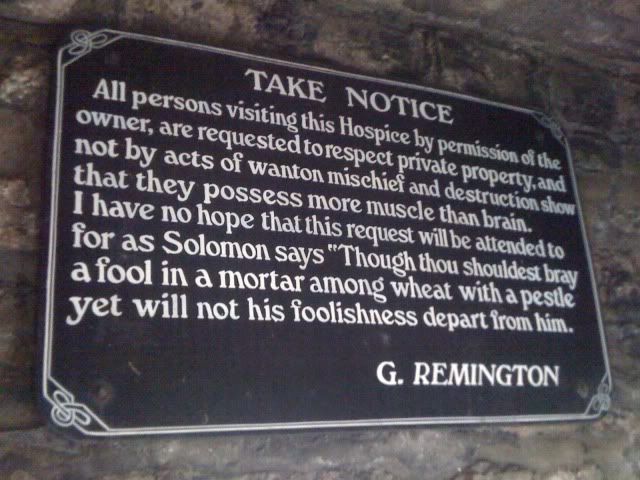
This first notice politely asks visitors to respect the property but actually states that it is not expected that people will do so - and this in 1846.

I coudn't get a good shot of the next sign in the confined space but it basically describes and explains the purpose of the hospice:

"This Hospice as an open door,
A like to welcome rich and poor;
a roomy seat for young and old,
where they may screen them from the cold.

Three windows that command a view
to North, to West and Southward too;
a flight of steps requireth care,
the roof will show a prospect rare.

Mountain and vale you thence survey
the winding streams and noble Bay,
the sun at noon the shadow hides,
along the East and Western sides.

A lengthened chain holds guard around,
to keep the cattle from the ground;
kind reader freely take your pleasure,
but do no mischief to my Treasure."

 There are no longer any cattle on the hill, but the chain remains keeping the plentiful sheep from wandering in. The building itself is in remarkably good health with no apparent malicious damage having befallen it.

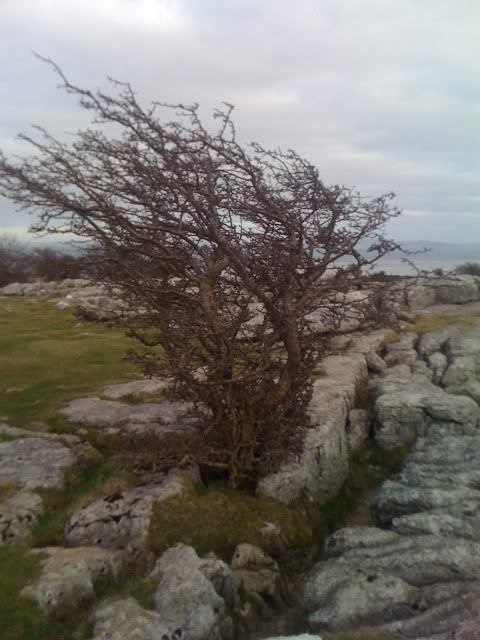
If it wasn't for the Hospice this would be a very barren, lonely place to find yourself on a cold, wet night. What trees there are grow at a very strange angle, permanently bent from the fierce winds.


During the day though the view is spectacular. The clever vicar had precarious steps built up the outside of the Hospice and a viewing platform added to the top of the building.

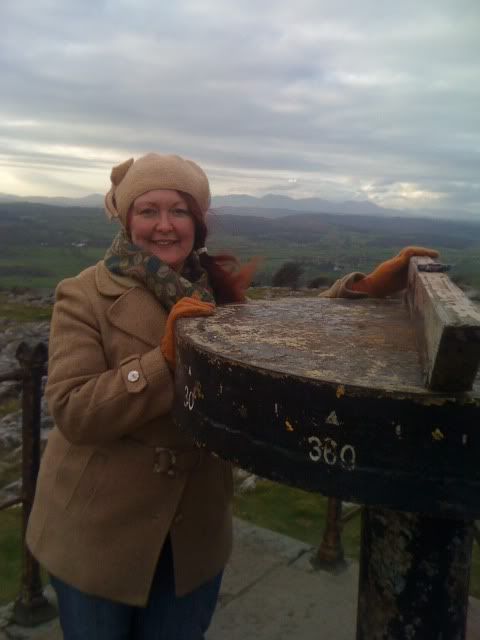
On the viewing platform is a huge compass with various degrees marked around its circumference.


 These degrees match up with a board detailing a list of places which can be seen from the platform.


This affords panoramic views from Snowdonia, across the Irish Sea to Lancashire and the Pennines, then mountainous North Cumbria then to the coastal areas around Barrow. It is a truly amazing sight.

click the image for a full size version

 for now
Ruby xx

Monday, March 19, 2012

Jean Moss and me

The title of this blog post may come as a bit of a surprise, particularly to the legendary Jean Moss herself, but when I was asked to take part in the blog tour for Jean’s latest book, "Sweet Shawlettes", I knew I wanted to write a little about the Jean Moss who has influenced me so much.


In 1991 as a young wannabe knitwear designer I purchased Jean’s first book “Designer Knits Collection”. I was sold! With its beautiful photography and Jean’s obvious love of vintage fashion I couldn’t have asked for more.


Two particularly gorgeous designs ‘Berlin’ and ‘Vienna’ really helped cement my love of 1930s knitwear and styling.


Jean also began designing for Rowan who were young, vibrant and offered cutting edge design. One of Jean’s designs ‘Monotone long sleeve sweater’ featured in one of my favourite Rowan books of all time - number six, and I knew I wanted to be like Jean one day.


Later into the 90s, as a struggling newbie at Rowan, I got the chance to assist Jean in a workshop. I was completely awe struck and as a result probably completely useless, but I loved every minute of it. I particularly remember learning double knitting on that day - as well as a number of knitting related folk songs - and thinking about that really helps explain the breadth of Jean’s skills and talents. At that time patterns in the UK didn’t really feature advanced skills such as double knitting, patterns didn’t always have schematics or full colour charts, but Jean’s did. I feel Jean really helped drive knitting and pattern writing into a new era whilst at the same time still producing stunningly creative designs, which brings me neatly to "Sweet Shawlettes". The book itself is beautifully produced with exactly the sort of top quality photographs and styling that one would expect in a book from Jean. The concept of the book, which is a collection of cowls, capelets, shawls, scarves etc., gives Jean free reign to incorporate unusual and interesting techniques and also celebrate her love for colour. The range of patterns also ensures there is something for everyone.

The book is divided into chapters, such as Folk and Country and very pleasingly, Vintage.
Not surprisingly most of my favourite designs in the book feature in the Vintage chapter. The first of these ‘Fizz Capelet’ is beaded and shaped using short rows and is so very very pretty. The art deco shade of blue also appeals to me immensely.


My absolute favourite though is ‘Treasure Jabot’. I thought I was the only person left using the word jabot, so I instantly felt so much better seeing it in Jean’s book. This delicate frill is worked in DK weight pure silk and would be equally lovely in alpaca or cashmere for christmas gifting. What I really love about it though is the very clever way the jabot is knitted and makes use of lots of the ‘re-found’ techniques which Jean has always known about.


There are many, many more beautiful designs such as the ‘Mantilla Shawlette’ and the ‘Arabesque Scarf’ which really makes this a timeless book. A book which I could happily keep returning to for years and years .


If you would like to own a copy of “Sweet Shawlettes” Taunton Press and Jean Moss are kindly offering one of my readers the chance to win a copy. Just go to the projects gallery  on Jean’s website before returning to my blog to leave a comment, letting me know your favourite design and why you chose it.  You must include your email address so that I can let you know you’ve won. I’ll choose a name at random next Monday - 26th March 2012.

If you want to find out more about Jean’s designs, workshops etc. you can find out more on her website.

The tour is nearly over but you can take a look back at what these other fabulous people also think of “Sweet Shawlettes”

Wed 7 March: Jen Arnall-Culliford
Thurs 8 March: Needled (Kate Davies)
Fri 9 March: Rock and Purl (Ruth Garcia-Alcantud)
Sat 10 March: Woolly Wormhead
Mon 12 March: Yarnscape (Alison Barker)
Tues 13 Mar Confessions of a Yarn Addict Anniken Allis
Wed 14 March: Joli House (Amanda France)
Thurs 15 March: This Is Knit
Fri 16 March: The Knitting Institute (Knitting Magazine)
Sat 17 March: Life’n Knitting (Carla Meijsen)
Sun 18 March: ConnieLene (ConnieLene Johnston)
Mon 19 March: Just Call Me Ruby (Susan Crawford)


The tour then continues with a final three dates which are:
Tues 20 March: Tiny Owl Knits (Stephanie Dosen)
Wed 21 March: Ulla-Bella (Anita Tørmoen)
Thurs 22 March Heike Knits (Heike Gittins)

You can also purchase the book directly from Amazon if you can’t wait to find out if you’ve won a copy.

Jean has had some very sad news this week and I would just like to take this opportunity to say my thoughts are with Jean and her family.


for now
Ruby x

Photos courtesy of Alexandra Grablewski/Taunton Press, Reed International Press and Rowan Yarns

Saturday, March 17, 2012

Knitted Swimsuits

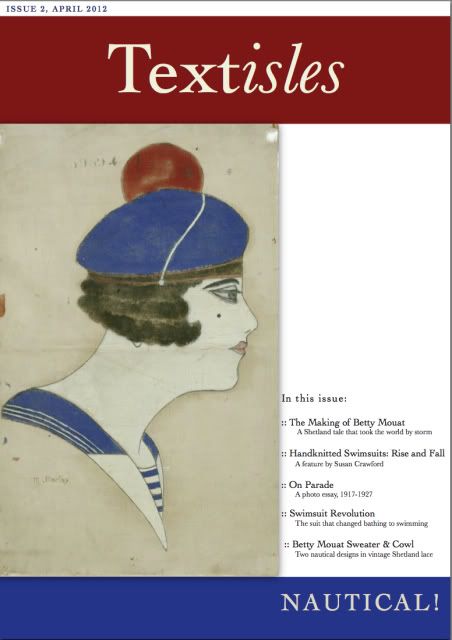
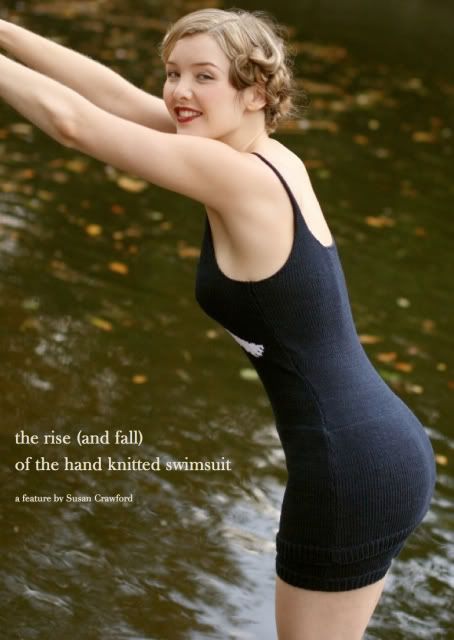
I have a bit of a liking for hand knitted swimsuits - and in particular hand knitted swimsuit patterns so imagine how delighted I was when the wonderfully talented Kate Davies asked me to write about knitted swimsuits for the next issue of Textisles (issue 2).


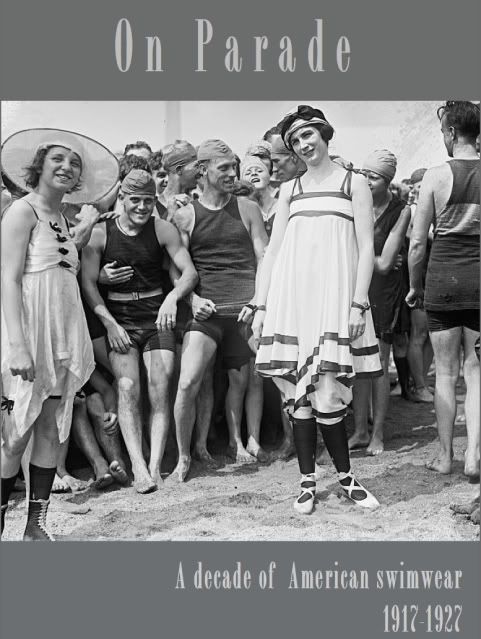
If you don't know about Textisles, it is a digital magazine, containing original designs and writing, all produced and edited by Kate. The magazine contains no adverts and is carefully produced around a theme - on this occasion, knitted swimsuits and designs and stories with a nautical air. As part of each magazine Kate creates at least one pattern inspired by and related to the theme alongside four extensive fashion and textile related articles. Being in the lucky position of having seen a draft copy of this issue I can say that I found Kate's article about the Swimsuit Revolution fascinating and the pictorial essay of swimsuit parades through the ages an absolute visual, vintage treat. Three are some amazing outfits in the photos Kate has gathered from 1917 to 1927.


My own feature begins with a familiar image from A Stitch in Time, Vol 1:


I share some of my favourites, look at construction, fabric content, fashions, the popularity and decline - in short, the rise (and fall) of the hand knitted swimsuit.

If you wish to purchase this beautiful publication you can do so only from Kate. The entire digital magazine, including patterns, costs only £3.95 and the magazine will be available from early next week. If you can't wait Issue 1 is still available to purchase right now

 
To celebrate the publication of the issue next week,  I'm planning a whole knitted swimsuit related blog post, so if anyone in the meantime has any photos of themselves or family wearing a knitted swimsuit that they wouldn't mind me sharing on the blog I would love it if you could email me the images and some information to susan (at) susancrawfordvintage [dot] com.

Thanking you in anticipation!!

Ruby xx

all images copyright Kate Davies ©2012 except for final image, copyright Susan Crawford ©2008

Tuesday, March 13, 2012

Featured Designer

I picked up a copy of the excellent new knitting magazine Knit Now yesterday. It is published right here in the North - Manchester to be precise - and focuses on small projects to knit, accessories, baby wear etc. It seems to have really successfully found its niche and has some great patterns within.

Here's the cover for the latest issue


The other thing it has is great features! You can just see up on the right hand side "Vintage Made Easy" with designer and stylist Susan Crawford - that's Me! After a trunk show at Purl City Yarns I met with the magazine's editor and had a really great chat which resulted in the interview contained within. We talked for quite a long time and I believe a significant amount of editing was needed.

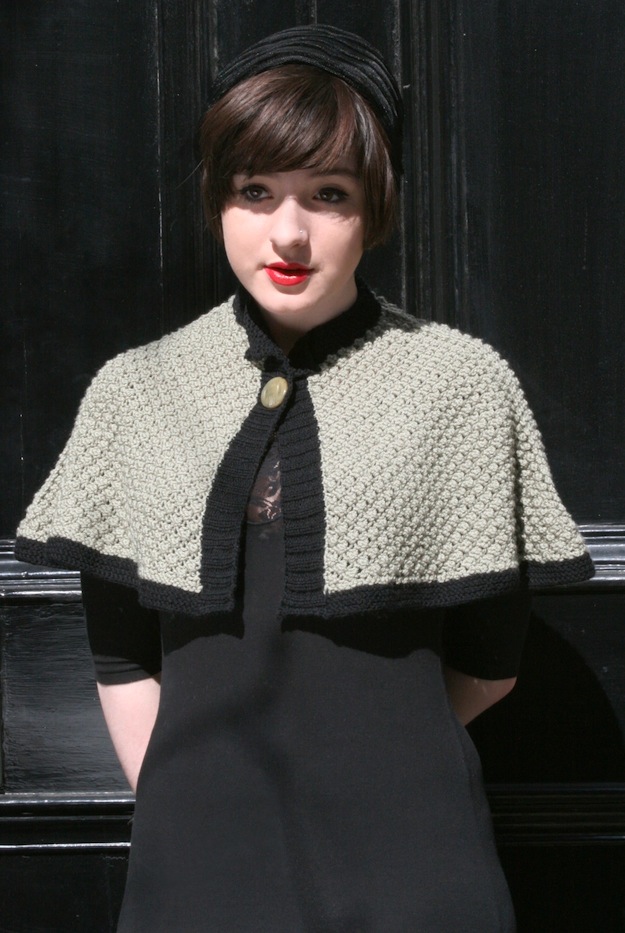
You can also just spot the lovely Charlie in the Town and City Tufted Cape, the pattern for which is also included in the magazine.


You may know the cape from Vintage Gifts to Knit. This little cape is quick to knit and is great to give as a present as the sizing is so forgiving.  My apologies for the strange line across the top of the second photo. My blogger has been misbehaving dreadfully and isn't importing images correctly!

The Tufted Cape is knitted in a DK weight yarn and as such is suitable for using Excelana DK which will be available very, very shortly. We have added the yarn to the shop and orders can now be taken for despatch when the yarn is in stock. The yarn requirements are as follows:

5 (5, 6) balls shade Nile Green (MC) Excelana DK
1 ball shade Persian Grey (CC) Excelana DK


It had originally been planned for there to be a special offer available to readers for both Vintage Gifts to Knit and for advance purchases of Excelana DK but unfortunately they were missed off the final article. So as the discount codes are all set up I thought it would be a shame not to use them so am offering the discounts to all my blog readers:

FOR 10% DISCOUNT
 ON ALL ADVANCE ORDERS OF EXCELANA DK 
PLEASE QUOTE:

KNITNOWEXCDK 
WHEN PURCHASING YOUR YARN


TO PURCHASE A SIGNED COPY OF VINTAGE GIFTS TO KNIT 
FOR ONLY £10 INSTEAD OF £14 PLEASE QUOTE:

KNITNOWVGTK
WHEN PURCHASING YOUR BOOK

for now
Ruby

Sunday, March 04, 2012

Before Knitting there were Books!

A working visit to the British Library yesterday reminded me of a very strong, almost obsessive connection that I have always had with printed matter and particularly, books. I have always been completely obsessed with them. As a very small child, books were the centre of my universe. I have read voraciously all my life, and collected books with even more enthusiasm than knitting patterns or wool. But then of course, knitting patterns come in the form of booklets, pamphlets and full scale books and this two pronged obsession has, I have recently realised, produced my own ever growing archive about knitting, sewing, craft and yesteryear in general. I have hundreds of books and thousands of patterns and at some point I am going to need to make sense of it all, to start creating a proper archiving system - that's how big it is getting! However on this dark and dismal March morning, when Spring has declined to join us, I thought I would share some of the 'Collection' (sounds rather grand, but I guess that's what it is).


 These first two books focus on craft in general in Elizabeth Craig's book and specifically on dressmaking in Home Dressmaking - interestingly, this book is devoted to hand sewing only - no sewing machines in sight!

Elizabeth Craig's book has some beautiful images of techniques, such as these elaborate drawings of working buttonholes, but I particularly like Home Dressmaking's section on 'New from Old' which explains how to fashion something new out of old clothes and gives a three page list of possibilities:
These next three books are from my Flora Klickmann titles. Flora was the Editor of 'The Girl's Own Paper' and 'Woman's Magazine'.
 Another of my favourites is the John Paton Knitting and Crochet Book. This is the third edition with it sumptuous woodblock cover, which was printed in 1903.
 It has a vast array of knitting recipes within its covers. This is the contents list for the Chapters within and is compiled by M Elliot Scrivenor who was the needlework correspondent to the 'Queen' newspaper and late manageress of the Technical Institute of Needlework, London.
 This next image is a tiny sample of some of the woman's magazines and pamphlets I have, including Woman's Weeky, Woman's Own and the Lady.
 This model crops up almost every week in Woman's Weekly and I would love to know who she was.

 I now have a sub-collection of both Munrospun and Lux books.
 I adore the Lux books and the idea that you got the books through purchasing packets of Lux washing powder. I can't imagine a major washing powder manufacturer going to such lengths these days.
 This next book goes off on a slightly different tangent, but I love Mending and Repair books of all kinds. This one looks at all sorts of home repairs including
 wallpapering the ceiling - the chap photographed here appears throughout the book - always with the same amount of solemnity as he shows here -
 to how to press a suit. I love books that show domestic tasks beyond those we would probably think of as needing written instruction and that such care was taken with possessions.

 On that subject, this is probably my favourite of the mending books that I have. The Art and Practice of Mending was a Pitman publication from 1933.
 The front cover alone makes the book worth owning but the illustrations are absolutely beautiful.

 Here is a selection of some of my Odhams books - I have many more!
 and the Encyclopaedia of Knitting by none other than James Norbury also published by Odhams
 This one is a US publication which is very similar to the Odhams books but is written by Alice Carroll who was the Consultant on the American Red Cross Knitting Manual. Her Complete Guide to Modern Knitting and Crochet was published in 1947.
 The Pictorial Guide to Modern Home Needlecraft is another Odhams publication - I have two versions of this book, one published in 1938 and the reprint from 1946.
 The 1946 reprint has this marvellous plate added at the front of the book, marking its chronological identity perfectly, and with the caption:


'With the right tools, a little patience, and a good knowledge of the basic principles of needlecraft, dressmaking for yourself and the family will prove as easy as ABC, and you will be able to take pride in saying "I made it myself"." With the timing of this republication maybe it suggests that there were many women who had not had time to learn these skills during the war years and were in need of instruction.

No collection would be complete without Mary Thomas's books. I also have her Embroidery book.

 A couple of contemporary books looking backwards are No Idle Hands which looks at the history of American knitting and also Knitting by the Fireside and on the Hillside which is not an easy book to get your hands on, which looks specifically at knitting on the Shetland Isles with an economic slant.
 These three books are amongst my most treasured. The Encyclopedia of Needlework is quite an easy book to find, especially as several million copies of this title were printed worldwide but it has some stunning plates and intriguing stitches to try.
 This tiny book though has some great gems in it
 such as this pattern for Siberian Cuffs. This little treasure is from 1847 and as was usually the case at this time, has no illustrations.
 The last of these three books and my absolute favourite is The Lady's Knitting Book from 1880. Again without illustrations, but I turn to this book again and again for inspiration.
 I also love the fact that the book is signed and dated - January 30th 81 (I am assuming 1881 by the style of writing, ink used etc) and love the idea that this was probably a christmas present based on the date. And again a lot contained within - 216 receipts.
It is also interesting that during roughly the same period the 'patterns' are sometimes called recipes and then other times called receipts. So close in spelling, did one come from the other I wonder?

So these are just a tiny part of my collection. The magazines and single patterns are too numerous to photograph individually but I'll try and share a few more at a later date.

for now
Ruby xx

All images copyright Susan Crawford © 2012 and must not be used with express permission being granted by the copyright holder.